Showing posts with label residential. Show all posts

Thursday, 30 January 2020

The Berlin Rent Cap - "Mietendeckel" is here. What Do You Have To Do?

Immediately after the law is published, probably in mid-February, a rent freeze applies as the first stage. The key date for this was June 18, 2019. Landlords are then no longer allowed to charge a rent that is above the value at that time. This rent freeze applies at least until January 2022.

Then, nine months later stage two, the most controversial section of the law follows with a rule that has never existed before: The Senate has established a rent table with prices that are based on the age group and fit out standard.

There are also surcharges: one euro for "modern equipment", for example with a fitted kitchen and high-quality flooring, and "location surcharges", a maximum of 0.74 euros per square meter in good locations. Including these surcharges, the absolute maximum price of a net rent in Berlin for a period of five years will be 11.54 euros - in this case for houses built between 2003 and 2013.

When the rent is 20% or more above the applicable table value the landlord has to take the initiative to reduce it.


What to do next?

If your property was completed 2014 or later - have a cup of tea and watch.

If your property is older, there are several things you have to comply with and they all require the landlord to become active or risk fines.

18 June 2019

This is the magic date of the rent freeze. When you are renting now, you are not allowed to exceed the rent of your property on that day. You are not even allowed to accept more if the tenant offers it (which is not unlikely in the current market situation). You would ave a long term legal risk because it is illegal.

Most likely in October 2020 you have to actively adjust your rent according to the table above with bonuses and reductions based on standard (e.g. fitted kitchen) or location, much like the rent table process already applied.

In a new post coming up we will explain in detail which steps a landlord in Berlin with residential apartments older than 2014 will have to take.

If you don't want to miss the updates, subscribe to this blog here on the right of the page.


Share/Bookmark

Saturday, 4 January 2020

Co-living - Currently One of the Most Promising Ways to Invest in Property

There are obviously many ways to invest in Real Estate. The Forbes Real Estate Council has looked at the current market situation and identified four trends that can be taken advantage of: Invest in a digital REIT, build a tiny home in your backyard, Angel invest in a Proptech startup or purchase a property for co-living.

Purchase a Property for Co-living.

I would like to dig into this option:

The Co-living movement is very much a reaction to the intensifying urbanisation and workplace nomads who can perform their job almost anywhere with internet access. Another driver is the ongoing price increase in urban areas around the world. Bigger units are hardly affordable, even for tenants with relatively high income.

Photo by Aw Creative on Unsplash


Investors are buying larger units with more than two or three bedrooms and rent the single rooms individually with shared, well equipped kitchen, bathrooms and lounge/living room. To meet the needs of the mobile generation most likely attracted to this form of living, certain standards have to be met: Fast WiFi, comfortable beds, security. A smart solution for laundry and responsive service in case of problems are a MUST.
On the financial side all utilities including e.g. electricity and TV-license have to be factored into the rent as they are key factors for mobility.
A set-up like this will command a much higher rent and, despite the inclusion of ancillary costs, a much better result than renting the entire unit to one household.

There are companies trying to offer just the shell room and will have some initial success in very tight markets but they will lose the tenants to more convenient set-ups as the competition is growing.

"It’s uncertain how large of a renter audience will be interested in this dorm-like life, but it’s gaining traction. Similar to the tiny homes, be sure to look into local zoning rules before purchasing a property." (Forbes Real Estate Council)


Share/Bookmark

Sunday, 8 July 2018

Global Cities Index Posts Weakest Property Price Growth Since 2015

Globally, urban prices are rising at their slowest rate since the third quarter of 2015. The Global Residential Cities Index, which tracks the movement in average residential prices across 150 cities worldwide, rose by 4% in the year to March 2018, down from 6.4% a year ago.
According to a new report by international real estate consultant Knight Frank, despite the global economy's strong performance, increased government activities to fight inflation in the real estate sector have slowed the price increases to some extent. While last year's report saw 12 cities with a growth of more than 20 % this years there is only one left in this bracket: the Indian city of Surat.

https://content.knightfrank.com/research/1026/documents/en/global-residential-cities-index-q1-2018-5666.pdf
Europe's growth path continues as 11 of the top 20 cities in the ranking for growth are in Europe. Previously in the top ranking Berlin (14.9%), Budapest (14.4%) and Reykjavik (11.8%) are now joined by Rotterdam (14.8%), Edinburgh (12%), Porto (11.7%) and Sofia (11.3%).

In Canada Vancouver continues to outperform with annual growth of 15.4% as tracked by the National Bank of Canada.

In the US Seattle (12.9%) continues to lead the 15 cities tracked by the index.

Southern Europe is increasingly polarised. Whilst Italian cities are well-represented at the foot of the table, Spanish and Portuguese cities are registering stronger growth. Porto, Malaga and Madrid all sit high in the rankings with annual growth of 11.7%, 10.4% and 10.3% respectively.

https://content.knightfrank.com/research/1026/documents/en/global-residential-cities-index-q1-2018-5666.pdf
The report also contains interesting insights in the bandwidth within countries which can go from + 22% to -5% within one economy.

For the full report just click on the graph or table above.


Share/Bookmark

Friday, 13 April 2018

Berlin, March Against Displacement and Rent Madness

More than 180 organisations and group initiatives have called for a "March against gentrification and rent madness". The march starts at Potsdamer Platz in Berlin on 14. April 2018 at 2 p.m. and was registered for 4,000 participants but 10,000 have already announced their participation via facebook.


Photo by Darko Pribeg on Unsplash

85 % of Berlin's population are living in rented accommodation which makes changes is rent levels felt by the overwhelming majority. Families have to leave the areas where they have lived for years, where they have formed social ties and where their children have been going to school. They just can't afford the rent increases anymore and in some cases have to move out of the city altogether.

Most of the declining numbers of newly built apartments are in the luxury segment out of financial reach for the local working population. Social housing has been neglected, affordable housing is not available.

Of the existing apartments many have been modernized in recent years and the organisers of the march are criticizing that those modernisations play a big part in the rent increases and displacements. E.g. a new lift and energy saving new facade easily run up to 20,000 € per apartment which will allow the owner to raise the rent by 11% or 2,200 € per year for this apartment.

Regulations like "Milieuschutz" are trying to put a limit on the type of modernisation that will be allowed in protected areas amongst other things, more details here: http://germanproperties.blogspot.de/2018/03/the-can-do-and-cant-do-renovating.html. But the organizers say that there are not enough protected areas especially in the inner city districts.

The federal government has already announced a new initiative to increase social housing but also to expand the regulations for local authorities to protect social structures in their cities.


Share/Bookmark

Saturday, 10 March 2018

The Can Do and Can't Do Renovating Apartments in Certain Areas of Berlin

Preservation Statute Areas -. “Mileuschutzgebiete” in Berlin. What can I do, what can’t I do with my property.

The prevention of so-called “gentrification“ is a central issue for the Berlin city government. The term “gentrification” is describing the process of displacing parts of the current population of inner-city areas through rent increases beyond their reach. This development completely changes the social structure of entire boroughs and destroys social networks and the associated support functions for its members.
The Federal Building Code (Baugesetzbuch, BauGB) includes a regulation that provides local authorities with a tool that is intended to avoid such a development. More details about the split of apartment blocks into individual condos and the English version of the building code can be found here:
https://germanproperties.blogspot.de/2018/03/thinking-about-dividing-apartmentblock.html

Section 172 of the code allows for the definition of protected areas under certain statistical conditions and for a specific time period of up to 5 years. There is a widespread consensus that after 5 years another 5 year period can be proclaimed and so on. It would be highly speculative and dependent on political significant changes to expect a change after 5 years.

There are two different criteria for protection which can be applied separately or in combination,
Social Preservation area § 172 (1) Nr. 2 BauGB and/or Erhaltungsgebiete with unique urban character § 172 (1) Nr. 1 BauGB

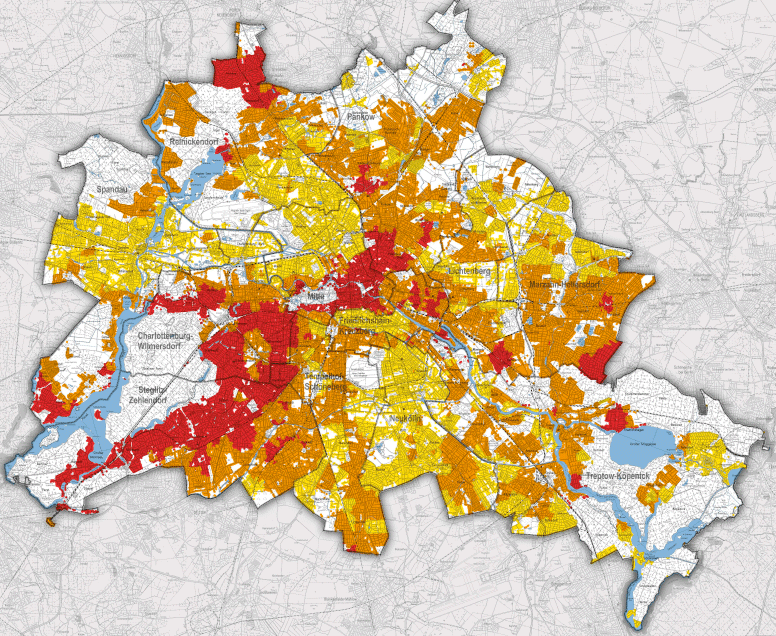
The map below shows the Berlin areas that are currently covered by individual Preservation Statutes (Milieuschutzverordnungen)

Source: Senatsverwaltung für Stadtentwicklung und Wohnen
For detailed information about the individual districts please visit our Blog: https://propertylocations.blogspot.de/

Social Preservation area § 172 (1) Nr. 2 BauGB

Examples of renovations or modernizations that are not allowed (examples)

  • Floor plan changes
  • Merging or splitting apartments
  • Extension of balconies, conservatories, loggias or terraces with more than 4 m² of floor space
  • Extension of second balconies, conservatories, loggias or terraces
  • Fitted kitchens
  • Installation of a second toilet, complex bathroom renovations

Examples of renovations or modernizations that are allowed (examples)

Refurbishments that only produce the "state-of-the-art" equipment of an average apartment must be approved. The resulting rent increases must be borne by the tenants in most cases.
To be approved by authorities (among others):

  • Initial construction of a central heating with hot water supply
  • Initial construction of a bathroom
  • Upgrade of an existing bathroom with modern equipment
  • Basic equipment with plumbing, water and electrical installations, antenna, cable TV and intercom systems
  • Replacement of existing windows according to the Energy Saving Ordinance (Energieeinsparverordnung EnEV)
  • Obligatory energy conservation renovations
  • Attic conversion and new construction
A post like this one is always restricted to general examples and can never provide an all-inclusive overview of all aspects. Before any action is taken and money spent we recommend a consultation with the local authorities.
We provide advice and guidance for these types of projects for our clients from the first steps of a feasibility study through to a business plan and completion of the project. For inquiries about our services please use our contact page .


Share/Bookmark

Sunday, 4 March 2018

Thinking About Dividing an Apartment Block into Condos in Berlin? What Could Possibly Go Wrong?


A growing number of owners of apartment blocks in Berlin are contemplating selling their property to take advantage of the high demand and increased prices. Instead of selling an apartment block in its entirety in one go, the sale of single condos is seen as a way to achieve higher prices per sqm and ultimately for the building in total.

The main issue I want to discuss here is the subdivision of an apartment block into single apartments in inner-city areas in order to be able to sell them individually.

Certain district administrations of Berlin, which are the local government in this context, have declared certain regions of their district “Milieuschutzgebiet”. These are areas where a Preservation Statute applies. Every area has a specific boundary and will quote specific regulations from Section 172 of the Federal Building Code (Baugesetzbuch).

These are the districts that already have preservation areas in place or are in the process of raising the empirical data needed to declare such an area:
  • Charlottenburg-Wilmersdorf
  • Friedrichshain-Kreuzberg
  • Lichtenberg
  • Mitte
  • Neukölln
  • Pankow
  • Tempelhof-Schöneberg
  • Treptow-Köpenick 

What is the impact on the owner?

In order to convert an apartment block into condos or individual freeholds (Eigentumswohnung) a permit from the district is required. In March 2015 the Berlin city government has released a regulation called “Umwandlungsverordnung” which allows the district to refuse the permit to divide (Teilungsgenehmigung) in areas under the Preservation Statute. Since preventing the “gentrification” of these areas through conversions is one of the purposes of declaring these areas “under protection”, the permit will be denied.

However there is another aspect to the story of the Preservation Statute which is not related to the division: The owner will not get a permit for what is seen a luxury modernization, e.g. new balconies bigger than 5 m², luxury bathrooms (definition in the regulation), join small apartments into big apartments, lifts and many other major works usually leading to rent increases.

What should I do?


If you are happy with your building and don’t plan to sell it in the near future you just need to keep your building in good shape and well managed, there is nothing you need to worry about.

However, if you are considering selling your property I recommend getting experienced local advice. There are different aspects of the business plan that might lead to different decisions when looked at in isolation as opposed to the total picture. Just to name some of these aspects, permits, tax, cost of marketing, timeline, first refusal rights of city and tenants (condos only) etc.. And it’s worth mentioning that sold individually you might not sell some units for years, at least not for the price envisaged.

Call me. We are specialized in guiding international investors through the ever-changing picture of market developments and regulations. Phone number

Academic / para-legal background.


The Federal Building Code allows local authorities to define specific areas for protection. This is done by means of local government procedures within the framework of the Federal Building Code. The regulations are spelt out in Section 172 of the code. All specific regulations will have to relate to this section.
Section 172 The Preservation of Physical Structures and of the Specific Urban Character of an Area (The Preservation Statute)

You will find an English version of the code here germanlawarchive.iuscomp.org


Share/Bookmark

Tuesday, 13 February 2018

The price boost on the German real estate market has further accelerated 2017


VDP-Real Estate price indices: The price boost on the German real estate market has further accelerated slightly 2017. With the results for 2017 The VDP also publishes the development of purchase prices n the top 7 cities for the first time.

The Association of German Pfandbrief Banks (vdp) represents the interests of the Pfandbrief banks in dealings with national and European decision-making bodies, and of a wider expert public.

Main findings of the report:


  • Residential real estate prices rise 6.9% year on year
  • Commercial property prices increase by 6.5% compared to the previous year
  • Expansion of the vdp real estate price indices with information on the housing markets of the TOP 7 cities in Germany
  • Housing markets in metropolitan areas remain strained: TOP 7 index rises 13.7% over the previous year
The full report in German is available here:


Share/Bookmark

Tuesday, 5 September 2017

Sharp price rises continue for condominium apartments in #Berlin - JLL Report First Half 2017

The sharp rise in purchase prices for condominium apartments continued in the first six months of 2017. Compared to the same period last year, asking prices for condominium
apartments rose by around 12.5% to €3,730 per sqm.

Source: JLL Residential City Profile Berlin 1st Half 2017


The trend of higher price rises observed over the past six months is therefore ongoing, and prices are continuing to grow at a similar rate as in the period between 2011 and 2014. The average growth rate since the onset of the current upswing which started in 2009, is 10.9% per annum. Purchase prices have risen by an average of 6.5% per annum, or by a total of around €2,130 per sqm since records began in 2004. If prices continue to rise, which appears likely at present, it is possible that the average purchase price will break through the €4,000 per sqm barrier, bringing Berlin up to the price level of Stuttgart.

Download the full report with details on all Berlin districts:

Residential City Profile Berlin - 1st half-year 2017

We provide support for finding the right property investment in Berlin - but we are not agents, or only in very few cases. Investors can rely on our impartial professionality. We don't only know about the sales process but also a lot about running a property to make it perform at its best potential.

Contact: http://www.berlin-portfolio.com/feedback.html


Share/Bookmark

Monday, 4 September 2017

Sharp Rise in Rents in #Berlin - JLL Report First Half 2017

Asking rents in Berlin increased to €10.80/sqm/month in the first six months of 2017, approaching the €11.00/sqm/month mark. The last time rents increased as sharply was in the first half of 2012. Then, the annual increase was 13.1%, compared to the current 12.8%. Since 2016, the housing market has returned to a phase of strongly rising rents. The upswing in the Berlin housing market began in the second half of 2006, initially with moderate increases (+3.0% per annum) until 2011, and then with significantly stronger momentum (+8.0% per annum).

Overall, rents have risen by an average of 6.1% since the beginning of the cycle in 2006, and have almost doubled over that period. Given the high demand and lack of supply, rents can be expected to increase further over the next six months.

Source: JLL Residential City Profile Berlin 1st Half 2017
 Download the full report with details on all Berlin districts:

Residential City Profile Berlin - 1st half-year 2017

We provide support for finding the right property investment in Berlin - but we are not agents, or only in very few cases. Investors can rely on our impartial professionality. We don't only know about the sales process but also a lot about running a property to make it perform at its best potential.

Contact: http://www.berlin-portfolio.com/feedback.html


Share/Bookmark

Saturday, 9 January 2016

Common Errors about the "Mietpreisbremse" (rent increase control)

On 1.June 2015 a package of new regulations regarding the German Residential Market became effective. Ever since, many confusing announcements and blog posts were published. Here are the essentials. I will focus on the Berlin Housing Market as Berlin was one of the first states having made all the preparations for the new regulation to be applied to the entire city from the first day.

What is regulated by the Mietpreisbremse package?

  1. ONLY contracts signed after 1. June 2015!
    Exception: Contracts with pre-agreed increases (Staffelmiete), these are limited to a net rent of not more than 10% above the Berlin Rent Table.
  2. The cost for the renting agent cannot be asked from the tenant, unless he has specifically instructed an agent to find an apartment for him. (The one who orders a service has to pay for it).

 What does this mean for you as the landlord?

Rent Level

First of all there is no immediate action required for either old (before 1.June 2015) or new contracts. Even if the agreed rent in new contracts is more than 10% above the rent table it is up to the tenant to contest the rent level providing the reasons why the rent supposedly is too high. Until and unless this occures the rent in the signed contract is owed.

Renting Agent Commission

This item is more risky for the agent than for the landlord as it constitutes an offence for him to charge the renting commission to the tenant and will attract a fine when reported to the local authorities. Whether the landlord has to pay the commission is not part of this discussion and depends on the direct contractual relationship landlord/agent.

What does this mean for the tenant?

Rent Level 

If the new tenant feels he/she is charged over the odds, immediate action is required: Checking the rent table for location, building age and standard compared to the rental contract. Should the contract rent be more than 10% above the rent table a reprimand letter IMMEDIATELY has to be sent to the landlord or management company. Only from this point a possibly lower rent is owed, before this point the contract rent has to be paid. Legal advice is recommended.

Renting Agent Commission

Should the tenant have received a charge for the renting commission for a contract after 1. June 2015 they should make a request for refund and/or report to the local authorities ( in Berlin it would be the "Wirtschaftsamt" as part of the local council "Bezirksamt"). Legal advice is recommended.


Share/Bookmark

Sunday, 6 October 2013

English Translation of the German Civil Code - German Tenants Rights

There is a lot of confusion amongst international investors about tenants' rights in the German Residential Market. One thing needs to be clarified at the outset, German tenants have more rights than investors from western societies are used to. The historical background is the vast destruction of residential buildings during the war and a need to protect the needy in a time of scarcity.

Now it has turned into an election ritual to improve tenats' rights prior to elections since the majority of voters in Germany are still tenants and not owners. The conservative Merkel government makes no exception in this game and has enabled local governments to limit the rent increase to 15% over a time period of 3 years just before the elections.


The main legal structure for tenancy law is the German Civil Code (BGB - Bürgerliches Gesetzbuch) and there is an official translation available on the website of the German Ministry of Justice:
The regulations regarding tenancy are in Title 5 of the code.

This will give you some idea what a paragraph quoted in a contract or legal document is about - but please refrain from making any legal interpretation on your own without legal council or at least feedback from your property manager. The German judicial system is not determined by precedence as much as the Anglo-American system but there is up to date high court ruling to be taken into consideration for the interpretation of the civil code. So the translation is to be used only as an indication of the subject that is addressed.

Uwe Falkenberg


Share/Bookmark

Friday, 14 June 2013

Berlin's Housing Market - Skyrocketing Prices | Made in Germany

This article was shown on DW - Deutsche Welle. It characterises the situation in the central districts of Berlin and highlights the fact that compared to other German and European cities this is only the beginning.


Use this Link if the video does not show: http://youtu.be/mIokc-VFKRA

An overview of price developments is available on our website. Provide your details on the left of the page and have the latest report sent by email.


For support in the identification of the right investment targets please visit our website at www.berlin-portfolio.com. Especially for international Private Investors and Property Funds we provide a task force service for quick reaction to interesting opportunities.

We provide independent support for the property search including foreclosure or auction properties and their valuation or appraisal. (Also see our free property market Research Service)

Please use this link to the contact facilities provided there to place any requests .


Uwe Falkenberg 


Share/Bookmark

Thursday, 13 June 2013

Berlin Housing Market Report 2013

Download the HousingMarketReport 2013 by GSW Immobilien AG and CB Richard Ellis.

For the most comprehensive and up-to-date survey of the Berlin housing market, more than 400,000 advertised rental, purchase and investment properties were evaluated and trends derived for both the city as a whole and its 12 districts. The Housing Cost Atlas provides information about rent levels, purchasing power and relative housing costs for 187 Berlin postcode areas.


For support in the identification of the right investment targets please visit our website at www.berlin-portfolio.com. Especially for international Private Investors and Property Funds we provide a task force service for quick reaction to interesting opportunities.

We provide independent support for the property search including foreclosure or auction properties and their valuation or appraisal. (Also see our free property market Research Service)

Please use this link to the contact facilities provided there to place any requests .


Uwe Falkenberg 


Share/Bookmark

Monday, 10 June 2013

Berlin Housing Market 2013 - What's up?

During the last few weeks there were some significant changes in the Berlin Housing Market.

Berlin Rent Table 2013

The new Berlin Rent Table 2013 (Mietspiegel 2013) was published and showed significant rises (20+ %) in some areas and hardly any changes in others compared to the 2011 rent table.

Location Grading for the Berlin Rent Table 2013
Location Grading Map of the Berlin Rent Table 2013

Reminder:

The official rent table determines the limit to which rents for existing contracts can be raised. Other regulations apply as well, (see below). The table does not apply to new rental contracts, even though tenants looking for apartments will tend to take their information from there.


New Cut Off Rate for Rent Increases

A change in the tenant law by the federal government allows the local governments at state level to reduce the cut off rate for rent increases in existing contracts from 20% over a period of 3 years to 15%. Two of the states, Bavaria and Berlin were very quick in applying this option and have issued regulations for Munich and Berlin respectively, meaning that as of March 2013 this new limitation applies. By the way,  both states have elections coming up this year as there will be elections at the federal level.

Setting up the right strategy

First of all - do not have your property manager send out a rent increase to all tenants at the same time, you might find yourself with more simultaneous vacancies than you would like. This really does happen!

Before applying the possible increases of the the rent table draw a development plan for your property. This does not necessarily mean spending extra money but have a guideline for you property manager where you want to be in 5 or 10 years. Some examples:
  • Use repairs and tenant changes for upgrades if this is what gets you into a better bracket within your location.
  • Groom some tenants that you would like to keep and take it easier on increases, engage them into a dialogue.
  • Take good care of the first impression of your property. If you want to attract tenants that are prepared to pay higher rents you have to do just that, attract them.
Falkenberg Solutions - Real Estate Consultants have supported the development of such plans. Good property managers should be able to help you but are often to involved in the property to take a step back for the assessment. Sometimes they would have to ask themselves why they have not done x or y long ago but this lies in the nature of being tied down in day-to-day business. A fresh look from a third party is often the best way. Click here to find out more about the services and/or contact us.

Berlin Housing Market Report 2013

Shortly we will send out the 2013 Berlin Housing Market Report with the latest developments for the different regions of Berlin. If you requested the 2011 report from us you will receive the update automatically. If you have not requested it, you could sign up for the 2012 Report here on this blog by using this link:
http://germanproperties.blogspot.de/2012/04/berlin-residential-market-report-2012.html
or you come back here as it will be announced soon. There is also a sign up box on our website http://www.berlin-portfolio.com.


Share/Bookmark

Friday, 25 May 2012

New Tenancy Law in Germany


Germany's government decided on an amendment to the tenancy law.


The most important changes:

  • Landlords can invest in energy efficiency measures, even against the will of the tenants. In turn the tenant will have a special lease termination right. Any disturbances arising from construction work must be accepted for up to three months without any reduction in rent.
  • The rent increase remains at 11% of the renovation costs per year, and examining the question of whether this represents an economic hardship for the tenant can no longer delay the start of work.
  • If a switch to energy contracting is made to improve the property performance, the cost can be distributed to the tenants if it is not higher than the previous operating costs.
  • Owners will now be able to more easily enforce the eviction of tenants in default.
  • In case of disputes, the courts may order the tenant to deposit the disputed amount until the end of the procedure.
  • Finally, the new law is to prevent the circumvention of protection against eviction (protection for three years against eviction due to future owner usage) in cases of apartment buildings’ being converted into condominiums.
These changes  make life for owners a lot easier and the rental market more balanced. They take away some of the uncertainty for international investors in Residential Property who see the legal regulations in the German Housing Market as very tenant-friendly.


Share/Bookmark

Sunday, 1 April 2012

Berlin Residential Market Report 2012

GSW / CBRE have published their 2012 Annual Housing Market Report for Berlin.


Main conclusions

  • Rents: Expensive rents get more expensive and moderate rents remain affordable.
  • Rent Burden: The average share of spendable income to be assigned to rent dropped slightly from 24.4% in 2009 to 24.2%.
  • Comparison: The Berlin Residential market still offers more for less than other German cities.
  • Scoring: Pankow, Friedrichhain-Kreuzberg and Treptow-Köpenick are in high demand with investors and in advanced positions on the investment cycle.
  • New building activities mainly in popular locations for high value customers.

For new contracts average net rents have risen by 7.8% from € 6.11 in 2010 to € 6.59 in 2011. The increase has varied and mostly took place in the higher value market segments to € 12.04 on average.
Least affected were the lower rents which increased by 4.6% to € 4.50 per sqm per month. There is still sufficient supply of affordeable apartments with a tightening of the market within the inner S-Bahn ring line.


For support in the identification of the right real estate investment targets please visit our website at www.berlin-portfolio.com. Especially for international Private Investors and Property Funds we provide a task force service for quick reaction to interesting opportunities.

We provide independent support for the property search including foreclosure or auction properties and their valuation or appraisal. (Also see our free property market Research Service)

Please use this link to the contact facilities provided there to place any requests .

Uwe Falkenberg


Share/Bookmark

Tuesday, 8 March 2011

Berlin Housing Market Report 2011

Download the HousingMarketReport 2011 by GSW Immobilien AG and CB Richard Ellis.

For the most comprehensive and up-to-date survey of the Berlin housing market, more than 400,000 advertised rental, purchase and investment properties were evaluated and trends derived for both the city as a whole and its 12 districts. The Housing Cost Atlas provides information about rent levels, purchasing power and relative housing costs for 187 Berlin postcode areas.


Grab your full Report


For support in the identification of the right investment targets please visit our website at www.berlin-portfolio.com. Especially for international Private Investors and Property Funds we provide a task force service for quick reaction to interesting opportunities.

We provide independent support for the property search including foreclosure or auction properties and their valuation or appraisal. (Also see our free property market Research Service)

Please use this link to the contact facilities provided there to place any requests .


Uwe Falkenberg 


Share/Bookmark

Monday, 21 September 2009

Berlin Property Market 2009 - Status and Outlook

Thanks to the financial crisis real estate values are in demand again. Investors increasingly focus on key figures of proposed real estate opportunities. The transaction volume has dropped considerably. The number of active market participants has reduced. In turn the market has become more settled and focused on results and not action. Less viewings to come to a transaction. Opportunist investors are very active in the market due to sales under financial pressure. International investors are less active some previously very active nationalities like Irish and Danish investors have almost completely vanished as buyers. They now appear on the sellers side due to financial pressures.

The buyers’ yield expectations are opposed to the sellers’ expectations but the gap is currently closing slowly. Closed special funds, insurances and pension funds, as well as owner-occupants and private investors dominate the scene. Interest rates for real-estate loans are still on a historical low. Banks, however, demand a higher equity share from the buyers. It has become more difficult to obtain a morgage. The benefit is with buyers who have sufficient own funds - equity is king.

Berlin Real Estate Market

With approx. 1.9 m. apartments Berlin is the biggest residential real estate market in Germany and the biggest German office real estate market. Berlin is a city of tenants with less than 13 % owner occupiers. According to economic data Berlin is still behind compared to other German major cities: High level of public debt, low growth rates, high unemployment, low spending power of the inhabitants.

But things are changing: Events like the 2006 Footbal World Cup, this year's Track and Field World Championship and numerous cultural events of international format have brought millions of visitors to the city providing income in the hospitality sector and related businesses. Also it has brought the idea of real estate investment in a comparatively under priced market to those visitors and their contacts back home.

The public authorities have modernized entire quarters, especially in ex-East Berlin, major projects have been started, the new airport Berlin Brandenburg International due to open in 2011 being one of them. The infrastructure is very good. Berlin is the seat of federal government and thus attracts decision makers from politics, lobby and business organizations.

Residential and mixed buildings

In the medium to long term the population will grow by 300.000 to 3.6 m. residents by the year of 2030; the number of households is growing. The rent level is still considerably lower than in other German major cities and other European capitals. The Berlin rents have been continuously rising in the last years, especially in popular and sought-after locations, even though a lot slower than anticipated by many investors during the boom years of 2005 to 2007 (see also recent postings on this blog). The demand for apartments is increasing.

Project developers are currently less active with a focus on housing developments for individual homeowners. The construction of new buildings remains on a low level and was actually decreasing during the past 18 months. We still observe a demand for typical Berlin pre war buildings focused on locations, such as Mitte, Prenzlauer Berg, Friedrichshain and the Western city centre, mainly Charlottenburg, Wilmersdorf, Steglitz and Schöneberg. Here demand is high and good deals are snapped up quickly. In demand are in particular properties in a range between 500,000 and 3,000,000 Euros with a yield expectation of a minimum of 7 %. As always the location is key. But also vacancy level and repairs backlog are clear knockout criteria especially for international investors. Saying this, there is a specific demand for development properties with purchase prices between 500 and 700 Euros per sqm in these locations.

Commercial real estate market

Tenants’ demand is focused on modern office space and retail units in the Eastern and Western city centres. The top rent is 20.80 Euros/m²/month and thus slightly declining. Peripheral areas are continuously becoming less important. On the other hand there are off center locations with a special edge: Adlershof for research and development and Friedrichshain with the Mediaspree area around MTV and Universal Music.

The sales volume has decreased considerably compared to previous years. Demand is reduced to prime properties, securely, long-term rented to blue chip tenants in good locations. New projects including modernizations are deferred or executed in such a way that allows short notice flexible response to changes in demand. Yields in medium and low end locations are therefor increasing. The top reail locations Kurfürstendamm and its side streets, Schlossstrasse in Steglitz, Friedrichstraße and Alexanderplatz in Mitte, as well as the touristy and cool locations around Hackescher Markt are in the focus and rents in locations with highdemand are naturally rising.

Outlook

Demand has returned to the market and is met by owners ready to sell at the adjusted market conditions. Yields for comparable properties have gone up by about 1.0% to 1.5% over a period of 18 months. In some locations demand is reaching or already exceeding supply. Conditions for investment are friendly: Interests are low, rents are high. The financial gearing of the past with 10% to 15% equity, sometimes even less are a thing of the past – pre Lehmann Brothers.

Shortly I will provide some actual price analysis of properties currently offered in Berlin. So come back to check or sign up to this blog.

Uwe Falkenberg

Uwe Falkenberg the author of this article is a Berliner and active in the German property market for more than 25 years. Experienced as project manager, developer and business owner he now operates Falkenberg solutions - Real Estate Consultans. His international background and local expertise is an ideal combination for an international investor.


Share/Bookmark

Friday, 5 June 2009

Residential Rent Development in Berlin

The Berlin Rent Table 2009 was published this week (see also yesterday's blog entry). The average increase of the net rent was 4 ct per sqm per month annually for the last two years since the last rent table, that is 1.7 % for the 2-year-period. In the same timespan the utility cost and heating (Betriebskosten und Heizkosten) increased on average by 5% to 2.35 Euro per sqm per month. Basically the increase in those ancillary costs is taking away the option for higher rent increases. Here should be an angle for optimising the performance of properties through Property Performance Improvement.

A more detailed analysis of the rent development in different market segments shows an interesting difference in the development of the net rent: The increase in rents for small apartments < 40 sqm over the 2-year-period was 5.3% to 5,41 Euro due to increased demand in that period. These apartments were especially popular with "New-Berliners".
For apartments between 60 to 90 sqm the increase was below average at 0.9 % for two years. This segment is still very low at 4.71 Euro per sqm compared with Hamburg at 6.53 or Munich at 9.90 Euro. Some segments have seen above average modernisation activities and thus above average rent increases. This applies to buildings from 1919 to 1949, 1950-1955 and 1973 to 1983 (the latter for ex West-Berlin). Here the increases were between 3.8 and 3.9 %.

The variation in the different market segments shows that a good asset strategy will yield better returns, even in times of slower rent increases. For support of the development of a successful property or portfolio strategy contact Berlin Portfolio Ltd.


Share/Bookmark

Wednesday, 3 December 2008

Residential Property in Germany - Better Performance

According to a current IVD study tenants in Residential Property in Germany have to spend more than one third of their net household income for rent and operating costs, in Berlin 40%. IVD is Germany's biggest organisation of property professionals like agents, property managers, valuation experts etc.. According to the study, the biggest factor for increases in the area of operating costs ("Betriebskosten" *)) was fossil fuels. The cost of heating alone rose by an average of 38% during the past five years and now has a share of 40% of all operating costs. The second largest block in the operation costs is water and sewage at 20%.

Even though there was a rise in the net rent in big cities, especially Berlin in the last 2 years the scope was limited by the sharp rise in operating cost. A good Property Asset Management will have to apply measures of Property Performance Improvement to create options for an increase in the net rent. For the tenants the bottom line of net rent plus operating cost determines the budget. A decrease in operationg cost will create scope for further increases in the net rent.

Uwe Falkenberg

*) For a free Glossary of German-Englsih Property Terms and a property newsletter you can sign up on our website www.Berlin-Portfolio.com


Share/Bookmark