Showing posts with label Residential Property. Show all posts

Sunday, 9 February 2020

A Flood of Updates and Interpretations on The "Mietendeckel" Rent Cap To Be Expected

You are the proud owner of a residential rental property, a buy-to-let plan?

If you have not heard about it yet, you will soon from your property manager or tenant. There are already various interpretations going around and none less than the German Federal Government is planning to take the regulation to the Constitutional Court in Karlsruhe.

Sign up

To recap the latest main events:

The Berlin city parliament voted on Thursday, January 30, 2020, to pass the rent cap “Mietendeckel” draft into law. It will most likely come into effect at the beginning of March, possibly as early as the end of February when officially published.
This will trigger numerous deadlines for actions required to be taken by the landlord.
The answer to a much asked question:
Yes it does apply to furnished apartments completed before 2014.
We are offering a newsletter, starting with a summary and interpretation of the law as it went into the parliamentary hearing. going forward, we will be providing hands-on tips on the communication and the timeline that needs to be met starting with the information needed.
Here is the opportunity for you to sign up to this free newsletter:

Don't miss the opportunity.


Share/Bookmark

Friday, 5 January 2018

Berlin's residential property market has been outperforming since 2006

Press release from: Accentro GmbH

Residential real estate worth 5.64 billion Euros changed hands in Berlin in 2016. This is the upshot of the latest ACCENTRO Homeownership Report. It suggests that revenues from residential property sales in Berlin almost tripled over the past ten years, up from just 1.97 billion Euros in 2006. ACCENTRO assumes that revenues will cross the mark of six billion Euros this coming year.

The ACCENTRO Homeownership Report highlights the brisk outperformance of Berlin’s residential real estate market over the past decade. It is perhaps best illustrated by the surge in the number of completions. While just 363 new-build properties were sold in 2006, the sales total was up to 5,608 properties ten years down the road, more than 15 times as many.


Equally unrivalled by any other German metropolis are the price hikes in Berlin. Between 2006 and 2016, revenues per residential property sold went from 96,141 Euros up to around 250,215 Euros, an increase by 160.26 percent. None of the other cities that were studied showed a comparable price growth.

Declining Number of Transactions, Rising Revenues

The above-average growth in revenue per sale is apparent not just in the ten-year comparison but in the short-term track record as well. Between 2015 and 2016, the growth in revenue per sale equalled 16.73 percent, whereas the 20 biggest German cities averaged a growth rate of merely 8.03 percent. Despite the fast growth over the past years, prices in Berlin remain quite affordable when compared to price levels in other major German cities. The German capital ranks only twelfth in terms of revenue per sale, trailing mid-sized cities like Heidelberg, Mainz or Regensburg.

Lately, however, the number of condominium sales has slowed in Berlin, or so the ACCENTRO Homeownership Report suggests. Specifically, the number of transactions dropped by 7.42 percent between 2015 and 2016. ACCENTRO blames the fact not on a lull in demand, but primarily on short supply. The fact that revenues in 2016 went up by 8.07 percent year on year in spite of the declining number of transactions reflects the persistently keen demand for residential real estate in Berlin.


For local support in the fast-moving Berlin Property Market 

Please visit our website for more details on our services and how we provide a Home Base in the German Property Market not only for international investors: http://berlin-portfolio.com/index.html


Share/Bookmark

Friday, 15 September 2017

Have You Recently Bought a Condominium Apartment in Berlin?

Many international investors have bought condominium apartments in Berlin during the last years. Some will have full-service packages taking care of everything, hoping that everything will be alright. Some have bought an apartment, maybe even coming personally for the handover, proudly looking at their apartment - but what now?

Photo by All Bong on Unsplash

Just a few points to be thought of, best done a few months before:
  • Who makes sure that any snagging is done right and timely while you are back home?
  • How serious will the developer be when his last payment depends on the tick in the box on snagging - do you trust him to be acting in your best interest without supervision?
  • Who holds the keys?
  • At what rent should the property be rented - or should it be rented furnished with short-term contracts?
  • If you want to go down the "Furnished Apartment" road, who takes care of this and who does the marketing for it?
  • Who manages your apartment and rent collection, including
    • Budgeting
    • rent collection incl. chasing if necessary
    • payment of contributions to the owners association
    • property tax payment (quarterly)
    • tax documentation and handover to tax consultant in Germany
    • representation at annual owners meetings

Critical Point in Your Investment

This is the point in your investment that is as important as the purchase contract. The purchase contract and all the brochures are a promise. Now it comes to the fulfilment of your expectations - don't leave it to the developer and the agent who received a healthy commission - either from you or the developer - to make sure your plans work out. Even more important if reality does not meet brochure - you want someone on your side who knows the game. It also is a critical point for reclaiming some of the money you paid for a promise that was not 100% fulfilled - the clock starts ticking on handover day.

Our recommendation

Be prepared, don't leave it until the last day. But even if your handover has already happened and you are in the midst of having to make decisions by the minute - get some professional support with local experience. Someone with broad knowledge, experience and solutions. Everybody can point out problems, the next step is much more important - what to do? You don't need a lawyer, an architect and a rental agent to identify your next steps, you need someone who "owns" and "lives" your property and then proposes other specialists when needed and with specific tasks. Otherwise, you are likely to receive long documents with lots of possible or even real issues attached to a big fee account and still no solution.

We don't offer off the shelf solutions because every investor has a personal view about the degree of their own involvement. We can go from one-stop-shop including the management of the investment to just the production of a checklist based on the contract and its documentation. We are happy to engage in a conversation to find out what you feel is best for you.


Share/Bookmark

Thursday, 7 September 2017

What is the best Property Location (In Berlin)?

In my career as a property professional I have heard plenty of advice about property investment and to come to the conclusion right up front -  there just is no lid that fits all pots.

There are investors with various investment philosophies, one that will go for prime locations for investment, put the lid on the pot and see what happened after 10 years. You know what, if it was not a major natural disaster area (take your pick) or politically unwise like Crimea, they will most likely be delighted about the value appreciation.
Now turning that theoretical value appreciation into cash through a sale to someone who believes in this new value is another story. This is an investment philosophy for someone who wants to park their money in a safe and useful way but does not need it for income purposes - this comes from somewhere else. They say that only poor investors look for income from property.

A different weathered property investor in the GERMAN rental market, the emphasis is on purpose, told me once that he would always invest in blue collar areas, anywhere in the world, because these are straight forward people who would do anything to pay their rent and stay out of trouble (eviction) as opposed to white collars who would rather pay a lawyer than their rent.

Let's take another angle:
If you invest 500k in a rented apartment(s) and buy a top tier apartment in Berlin-Mitte it would buy you 1 with about 60 m². How are you going to monetize it? Lock it up, air it once a month and run the taps and hope the authorities will not catch up on you for "housing speculation"? Rent it - furnished or not furnished? What will be the extra cost for furnishing and upkeep and frequent change of tenancy? How big will the gaps be? Did you choose the right location for furnished rentals? What is the cost of vacancy - 100% plus. You don't only not get the rent but you have to pay all utilities charges etc. (Betriebskosten) throughout the vacancy.
If you bought 3 apartments at the same price in a blue collar area you were hedging your bets: How likely is it that all three tenants would default at the same time? Given the current housing market, it is very unlikely that you would be facing a vacancy of more than one month on any of those three units. I think going into more details at this point would be insulting your intelligence ...


Now here comes what you have been waiting for while you were reading: My proposal for the income orientated investor. At this point, I have managed to source two offers for multi family properties that are a fair offer in the current market scenario and have room for improvement in the mid-term. Have a look at some of these locations and maybe you will get interested. ... https://propertylocations.blogspot.de/


Share/Bookmark

Saturday, 2 September 2017

Surprize Results In The Top 50 House Price Index: #Berlin at No.18 and Waterford, Ireland at 9

The Hurun Research Institute released the Hurun Global House Price Index 2017 Half-Year, listing the 50 cities with the highest house price changes in the twelve months to 30 June 2017.

China housing prices growing fastest in world

 6 Chinese cities in Top 10 & 21 in the Top 50

Toronto jumped 26% yoy, Number One in world

Hong Kong Top 5, with house prices rising 20.8% yoy

Wuxi fastest growing city in mainland China; Zhengzhou, Changsha, Guangzhou and Shijiazhuang in Top 10

USA, with 15 cities, led way for highest global property ROI (housing price change + RMB change + rental yield), followed by Germany (5), Australia (4) and Canada (4)


 The ranking for individual cities shows some surprizes:

Hurun Report 1-2017
Source: hurun.net
There are only 7 non-Chinese cities in the top 20 (blue frame) out of which 3 are European.

The report also looks at the ROI where Berlin ranks at No. 16. You can download the press release including the ROI ranking here ⇒ Hurun Report 1 - 2017 Press Release.


Share/Bookmark

Sunday, 19 March 2017

EMEA Investors Intentions Survey by CBRE: Germany at No.1 again with Berlin moving up to No.2 city


INVESTOR INTENTIONS SURVEY 2017

Berlin moved up to No.2
 The CBRE has arrived at these conclusions:
  • Economic conditions are positive and investors have ample capital to deploy in real estate
  • In EMEA, investors are planning for $475 billion in real estate investments in 2017
  • For 2017, 85% of investors intend to spend at least as much as in 2016, and 40% expect to spend more
  • Germany is ahead of the UK as the most attractive place to invest, as was the case in 2016, but investors are showing an increasing tendency to invest in the UK despite uncertainty over Brexit
  • The Nordics enters the top three with a significant jump compared to 2016
  • London retains the top spot as most popular city to invest in with an increased share, but Berlin shows the biggest increase, moving into second place
  • ‘Pricing’ and ‘Availability of product’ are the biggest obstacles to investing in EMEA real estate
  • Office is the most popular sector: interest in logistics has increased
  • Risk appetite has increased slightly
  • Income related factors such as ‘Yield relative to other asset classes’ are investor’s key motivations for investing in real estate
  The full report is available: https://researchgateway.cbre.com/PublicationListing.aspx?PUBID=6e0d802a-c164-48fd-acb3-1057547a0312 

Another interesting result is the preferred property type:


For support in property search and optimisation of property operation please visit our website http://www.berlin-portfolio.com


Share/Bookmark

Wednesday, 15 February 2017

German Housing Market Study Spring 2017


Investors have to expect a further rise in rent levels, as otherwise an acceptable yield could not be expected despite the low interest rates.

Berlin is currently losing its swarm town position

The immigration from inside Germany to Berlin, Hamburg and Munich has weakened considerably and is no longer enough to compensate for the increasing suburbanization. This is not the end of the swarm behavior, but the swarm continues to move into relatively more favorable cities such as Leipzig, Rostock, Erlangen or Regensburg.

"Lucky" sequence of different immigration waves

The cause for Berlin, Hamburg and Munich nevertheless experiencing almost constant immigration, is due to a "lucky" succession of different immigration waves from abroad. These, however, have reached their climax. If there is no further immigration wave from abroad, the three cities are expected to experience a sharp slump in the growth of housing demand.

Falling demand with increasing supply.

At the same time, as the "housing construction machine", especially in Berlin, is increasingly taking off and larger and larger projects are being planned, under construction or near completion, the housing supply will be expanded strongly in the near future. As a result, the rise in the new contract rents will soon come to a halt.

A free summary version of the study is available at this link:

For support in property search and optimization of property operation please visit our website http://www.berlin-portfolio.com


Share/Bookmark

Tuesday, 17 January 2017

German property investment market ends year with extraordinary strong fourth quarter

In their latest quarterly review (Q4 2016) JLL shows a record 4th quarter but a decline of the total annual transaction volume compared to 2015. Last year had actually the third highest volume.

Transaction Volume Germany quarterly 2017
Source: JLL Research
There was a Slight dip in demand in the Big 7 and Frankfurt reclaims its position as the investment capital. This map shows the Transaction Volume 2016 by Region
:
Transaction Volume 2016 by Region
Source: JLL Research


Further observations mentioned in the report are:
  • All asset classes feature on the shopping lists of national and foreign investors.
  • Further yield compression with increasing capital values.
  • No fundamental change in investment strategy.
  • Above-average residential transaction volume despite lack of megadeals
Residential Transaction Volume, Germany
Source: JLL Research
 
The full report is available on the JLL Research website http://www.jll.de/germany/en-gb/research/1472/investment-market-overview

For property search and purchase support please visit our website www.berlin-portfolio.com.


Share/Bookmark

Wednesday, 11 January 2017

German Residential Property: Price pressure remains high.


Purchase and lease levels in residential markets across Germany are expected to keep rising in 2017. This is the result published in a market report by Deutsche Bank Research, download the report in German here https://goo.gl/ab33hQ.

Macro-economic conditions that could indicate an end to the current price rally are not moving in that direction: Reversal of interest policy, significant increases in available property, or declining immigration, are not in sight in the foreseeable. The most dynamic city according to the report il be Munich; the high gravity for new residents and very low vacancy rate should keep prices on the rise for several years to come. This also applies to Berlin, in this case, because of the still-low price level and excellent labour market development. Frankfurt is already showing a Brexit effect in anticipation of London bankers with deep pockets, prices of single family homes have climbed 11.25 % compared to the previous year (other metropolitan areas 6%). Hamburg is showing declining lease activity and busy construction dynamics, while Düsseldorf has a relatively high vacancy rate. Rising interest would have a slowing effect on price increases in these cities.

For more in-depth information about the German property market and especially the Berlin Housing Market you might want to subscribe to this blog and visit our website http://berlin-portfolio.com.


Share/Bookmark

Wednesday, 9 March 2016

Why German Property Market Remains Attractive in the Next 15 Years

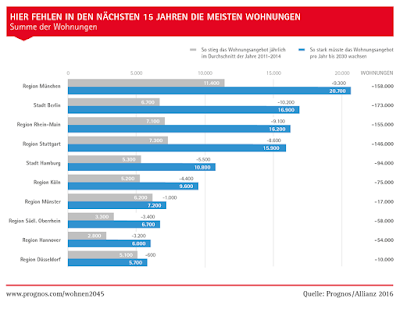
The housing shortage in Germany will grow if there is no significant increase in building activity. According to a study Prognos AG has delivered for Allianz Building Finance in the 15 most dynamic local markets there will be a shortcoming of close to one million apartments in the next 15 years. The 10 regions with the biggest supply deficits are München, Berlin, Rhein-Main, Stuttgart, Hamburg, Köln, Münster, Upper Rhine region (Freiburg/Offenburg), Hannover and Düsseldorf. The situation could relax by 2045 but only if there is no slacking in the building activities. Despite current immigration and refugee influx the main driver behind the development is internal migration which is currently responsible for 73% of changes in the housing market.

1 Million Apartments Gap in Germany 

The full report in German is available here: Prognos Living in Germany 2045
For support in property search and assessment in the German Property Market please contact us directly: Contact form


Share/Bookmark

Sunday, 21 February 2016

German Housing Market – Price Development in 2015 (Deutsche Bundesbank)


The German Federal Bank (Deutsche Bundesbank) has provided an analysis of the developments in the German Residential Market in their Monthly Report February 2016 https://www.bundesbank.de/Redaktion/DE/Downloads/Veroeffentlichungen/Monatsberichte/2016/2016_02_monatsbericht.html. The analysis is based on research data published by other institutions like vdp (Verband deutscher Pfandbriefbanken) or bulwiengesa AG.

 Price Development

In 2015 the prices for residential properties saw a significant increase. The spread across the country was wider than in the previous year. The price effect of growing demand combined with continuing favorable financing conditions was again stronger than any increase in availability of housing. Based on price determining economic and demographic factors the value of properties in urban areas will remain high and growing.

Based on information by bulwiengesa AG, prices for residential properties in German cities increased by 6% in 2015 after 5.5% in 2014 and 7.5% in 2013. The prices increase for condos was 6.5%, higher than single and semi-detached houses. Also the price increase for multi-tenant blocks was higher than the annual average since the beginning of the recent upswing in the German property market.

The average price increase for residential properties across all types in big cities slowed down compared to previous years and was the same as in cities in general at 6.25%. The increase for apartment blocks was at 7.25% by 2.0% higher than the average since 2010.

Rent Development

For new rental contracts in cities the increase was at 3.25% close to the previous year’s figure whereas the rent increase for new built apartments slowed down. In big cities the slow down on both categories was discernable. Whether this was due to the rent cap introduced in 2015 in Berlin, Hamburg, Düsseldorf, Frankfurt a.M., Köln, München Stuttgart and several smaller cities and towns.

Economic and Financing Development

The steady economic development in Germany with positive outlook for income and employment supported a strong demand in the residential market. While the price-income-ratio for owned housing increased over the period of the last 3 years the average interest rate decreased in 2015 by 0.5% to fewer than 2%.


Share/Bookmark

Tuesday, 10 November 2015

Investment in Berlin Residential Property – The Time is Now

In a world of “cheap money” because of monetary policies by the FED (Federal Reserve System, US Central Bank) and the ECB (European Central Bank) banks are not rewarding deposits of any kind but are able to hand out money at low interest rates if the collateral security is right. Stock market speculation of any kind is one option but requires the investor’s attention and is somewhat volatile. Property is always considered a more conservative, safe and care free option especially for the long term. One of the main motivations is the relative stability of value (increase) compared to other assets. Keeping this mind-set in focus, a typical property investor will expect value development (appreciation) at least as much as on income creation (yield). There might be locations with higher yields than Berlin but there are not many places that can promise a stable outlook on value appreciation quite like this city at the moment.

Berlin residential property has become a main focal point for international property investors - for various reasons.

The Outside View

Being involved in a market (I was born and grew up in Berlin) always carries the danger of one being “blinkered” and it is important to take an outside view. As Warren Buffet said: "Don't ask your barber whether you need a haircut".Only in recent days there have been international publications on the subject and I would like to share some of them. Very interesting reading , you will find that some of the articles I am suggesting to you will quote similar sources, big property agents with a vested interest, should be taken with a pinch of salt but behind the sales talk is a big piece of truth.

Berlin Carries On As Europe’s Property Investment Star - Square Foot.com.hk

Berlin has been on a property tear in the last few years. The German capital has seen faster price growth than any other location in the country — including traditional economic and banking hubs at Munich and Frankfurt — and it has emerged as one of the best investments in Europe. Building is finally on the rise, giving international investors more opportunity to enter the market. But is the primary market the only way to go?
http://www.squarefoot.com.hk/news/709/berlin-carries-on-as-europes-property-investment-star-/

New Berliners Propel Property Prices · Handelsblatt Global Edition

As Berlin keeps attracting more young, creative people from around the world, new districts are becoming more popular – and expensive.


https://global.handelsblatt.com/edition/301/ressort/finance/article/the-new-york-of-europe
A more inquisitive but in the end confirming and not contradicting view is represented in this article:

Berlin Devises New Methods To Solve Housing Crisis - TheUrbanDeveloper.com

Berlin, Germany’s largest city is facing a housing crisis as the city’s population soars as it has become a magnet for European youth and also grapples with the effect of the continent’s migration crisis including asylum seekers from Syria and further afield.
http://www.theurbandeveloper.com/berlin-facing-houisng-crisis/

These recent examples of publications are in agreement about the reasons for the focus on Berlin Residential Property.

The Inside View

Making a career in the Berlin Property Market since 1981 in various roles and responsibilities we have seen many ups and downs but nothing quite like the current development. Today, on the 26th anniversary of the famous press conference that sent the Berlin Wall tumbling in 1989, Berlin is not seen as the center of political tension anymore but named alongside New York, Paris and London as one of the world’s prime locations, especially for young creative people.

‘The New York of Europe’ · Handelsblatt Global Edition
URL: https://global.handelsblatt.com/edition/301/ressort/finance/article/the-new-york-of-europe

There is talk of gentrification and displacement of incumbent tenants in the central districts of Berlin (Mitte, Prenzlauer Berg, Friedrichshain, Kreuzberg, Schöneberg, Wilmersdorf and Charlottenburg and in some specific parts of Neukölln and Steglitz) and political action has been taken. Mainly these are: - Capping rent rises at 15% within 3 years on existing rental contracts,
- new contracts exceeding the current rent table by not more than 10%
- and other measures to prevent costly modernizations resulting in significant rent increases in defined protected areas,
to name the important measures, some are more specific for property developers and dealers.

At the bottom line these measures don’t reduce the attractiveness of Berlin Residential Property much because the restrictions of market reality are probably more stringent: A 5% rent increase per year would be nice to have! So the political action can be rated as action taken for the next election but not causing real harm.

One of the key issues in delivering the anticipated and calculated results is the right choice of property management and instruction of the property manager. For a long time operating in a highly regulated and predominantly local or at least German Property Market many of the local property managers have no understanding of the needs and expectations of international property investors. Assumptions on both sides, property manager and investor, leads to disappointing outcomes as we have to witness again and again when called in to fix issues. (There will be separate information on this topic available shortly).

Currently, demand for residential investment properties is high and supply somewhat scarce and the outlook for investments is good. It is important to secure opportunities now. Demand for housing in Berlin is constantly growing while building permits and building activities cannot keep up with it. The demand is pushing into the peripheral regions of Berlin with unprecedented rent levels. The pressure on the housing market is intensified by the influx of refugees widely referred to as “refugee crisis”.
Conclusion

The current demand for Berlin Residential Property is in no way a “Property Bubble” as there is a sustainable growth in demand for housing and investment. Especially in times like this, opportunists are flooding the market with dubious offers and big promises. There is a need to assess the real risks and opportunities in an investment, whether apartment blocks, luxury apartment or investment apartment. Last but not least the right Property Management is key in delivering all these great prospects. Even though the current development in the property market is far removed from the situation before 1989, the knowledge of the rules and regulations then are still important factors in understanding the market now.

We are experts in supporting international investors in finding their right investment and management of it. Talk to us before you make your decision, especially when you are a long distance investor. We are your home base in the Berlin property market


Share/Bookmark