Showing posts with label German property. Show all posts

Friday, 29 June 2018

German Property Finance - LTVs are Decreasing "Only" Due to Price Increase

Opinion:

A recent finance study by IRE BS Immobilienakademie states that the Loan To VAlue ration in German property financing has decreased from 65% to 61% since 2016 but "only" because of price increases. In other words, banks  don't believe that current prices represent the value of the properties they are financing so they are cutting back on their exposure.


Why is this supposed to be good news? It follows the calls form the Deutsche Bundesbank about a Property Bubble even though several demand based indicators don't support the view. Maybe if they keep it up for another 5 to 10 years, one day, they will be right.


Press release in German.

Purchase the report in German.


Share/Bookmark

Saturday, 30 December 2017

The Berlin Property Market - Outlook 2018

We wish you a Happy, Healthy and Successfull Year 2018


The German and especially the Berlin property market experienced a record year in 2017 and left quite a few loose ends to watch out for.

Rent levels in the German Big 7

... Berlin, Munich, Stuttgart, Frankfurt am Main, Düsseldorf, Cologne and Hamburg have risen significantly although at quite different rates. This applies to all market segments but is most outstanding residential properties in Munich and Berlin. Some market participants will tell you that the limit is reached and others will say that especially in Berlin there is still plenty of scope compared to other European metropolia like Prague or Warsaw.


Construction of new Apartments and Office Space

... does not keep up with demand in the big population centers and increases the upward pressure on rent levels.

Legal Challenges in the Residential Market

Almost all legal measures undertaken by the Federal Government and Local Authorities have been somewhat successfully challenged in court. Mietpreisbremse battle taken to Germany's Federal Constitutitutional Court Another challenge is the use of Airbnb by tenants and apartment owners.

Financing Property

... might become more expensive in 2018 as the inflation rate in December was at 1.8% the highest in 5 years. The main cause was the rent development and energy cost. This could have an impact on interest rates which in turn might have a slowing effect on property price increases.


These are just a few items to keep an eye on. Stay informed about the developments: Sign-up for updates from this blog and visit our website berlin-portfolio.com.


Share/Bookmark

Wednesday, 8 November 2017

Investors favour Germany over UK for commercial real estate for first time

One in three (33 percent) commercial real estate investors have suggested that Germany is their preferred region to invest in, according to the latest BrickVest commercial property investment barometer. According to the latest market barometer of 3,500 professional real estate investors from BrickVest, the online real estate investment platform, suggests that more than a third of professional real estate investors are trending towards Germany as their preferred region to invest in. This is the first time that Germany has been chosen as the number one region to invest in, ahead of the UK which was selected by a quarter (27%).


The Barometer also revealed that UK, French, German and US investors are now less favourable towards the UK since last year.
BrickVest’s Barometer also showed that the investment objective for the majority (55 percent) of its online investors is capital growth compared to 33 percent who said income. This is a good explanation for the popularity of Berlin Real Estate despite yield compression - appreciation.


Share/Bookmark

Friday, 3 November 2017

There Could Be a Way To Avoid Capital Gains Tax for Apartments in Germany After 2 Years

If you have bought or are planning to buy an apartment or a house in Germany this could be very valuable information for you. The base of the subject seems very dry but the impact is potentially very significant: It is the subject of “Capital Gains Tax”.


Read more here:

https://www.linkedin.com/pulse/how-avoid-capital-gains-tax-apartments-germany-uwe-falkenberg/


Share/Bookmark

Wednesday, 13 September 2017

Global Real Estate Market Perspective August 2017 As Seen by JLL

Renewed momentum extends real estate cycle


Global economic growth has invigorated real estate markets worldwide. Leasing demand remains steady, while investors continue to allocate a larger portion of their capital to real estate. Deal flows so far are in line with what we saw in 2016.

2017 Prospects
Capital Values Capital Values 6% Increasing
Rents Rents 3% Increasing
Develoitpment Development 28% Peaking
Vacancy Rate Vacancy Rate 12.1% Rising
Leasing Leasing 39 m sqm Stable
Investment Investment US$ 650bn Firm

Leasing, vacancy, development, rents and capital values relate to the office sector. Full-year 2017 forecast values. Capital values, rents and development figures refer to percentage change. Global vacancy rate - percentage value, leasing volumes in million square metres, investment volumes in US$ billions. Source: JLL, August 2017

There is a wealth of analytic information in the most recent report and we will look at it especially as it applies to Germany and compares to other reports. One item that sticks out when looking at residential investment in Europe is the JLL clock:
After all the persistent talk about aproperty bubble in Germany JLL research does not seem to confirm this for Berlin.

Some more headlines from the report:
  • Office rental growth quickens
  • Western Europe leads as most dynamic leasing market (office)
  • Global retail markets facing unprecedented structural changes
  • Logistics rents surging
Here is the linkk to the full report: https://goo.gl/RERdk6


Share/Bookmark

Wednesday, 6 September 2017

Deutsche Bundesbank: There is no property bubble in Germany

There are always those predicting doom and if they just keep doing so long enough they might be right one day and nobody counts the false alarms - they hope. The Deutsche Bundesbank (German Central Bank) does not belong in this category but is known for being very cautious about price developments, especially when they have an impact in banks lending policies for properties.

Only in May of this year Dr. Andreas Dombre, a board of directors member at the Deutsche Bundesbank warned about a price bubble building up in the German property market and the fact that you can't predict the actual "pop" only acknowledge when it happened.
Speech transcript in German:  https://www.bundesbank.de/Redaktion/DE/Reden/2017/2017_05_04_dombret.html#doc398274bodyText2

Photo by Markus Spiske on Unsplash

Asked about the topic at a press conference on 30.08.2017 introducing "Results of the 2017 low-interest-rate survey" Dombre stated that the Deutsche Bundesbank currently does not see a property bubble but fears a tendency that financial institutions are considering taking higher risks in residential property financing. Press release: https://www.bundesbank.de/Redaktion/EN/Pressemitteilungen/BBK/2017/2017_08_30_joint_press_release.html
 
Especially in the Berlin housing market, we are successfully sourcing off-market investment opportunities for private investors in the popular segment between 1 and 2 million Euros as well as high-end private homes and villas. For more information please contact us at: http://www.berlin-portfolio.com/feedback.html


Share/Bookmark

Sunday, 12 March 2017

How secure are you when buying off-plan property in Germany?

Buying Off-Plan Properties, i.e. properties that are not yet as they are supposed to be according to the purchase contract, can be seen as risky. This could be a family house or a condo yet to be built or renovated. There is a building specification and some material samples trying to describe what the property should look like when it is finished.
In an ideal world for the buyer, no money changes hands before the project is finished and the result is satisfactory. For the developer, there is the worry if the buyer can and will pay once the project is finished.
In the German legal system, there is a regulation with a monstrosity of a name: Makler- und Bauträger Verordnung (MaBV),  which can be translated as Agent and Developer Ordinance - not much better. I will ignore the part dealing with agents for this purpose.
This ordinance regulates when and under which conditions a developer is allowed to take money from a buyer or the buyer's bank. Yes, this is right, he can not only not ask for the money if the conditions are not fulfilled, he is not even allowed to take it if you offered it - who would?
The regulation defines 13 instalments of the purchase price related to the building progress. Only up to 7 instalments are allowed, meaning that the developer will provide a payment plan which will bundle some of these instalments.

Here is an infographic about the 13 instalments:


Instalments according to MaBV

To receive the full-size infographic and detailed information about all aspects of the security system for Off-Plan Property buyers in Germany including a translation of part of the actual regulation regarding the payments please leave your information below. After the usual confirmation email, you will receive an email with the download link and an extensive report.


Share/Bookmark

Friday, 17 February 2017

What are your personal information requirements regarding the German Property Market 2017?

Tell us your needs!


There was a flood of reports and surveys about the outlook on the German Property Market 2017, "Quo Vadis..." and whatever the titles might be. We are guilty, we have tried to cover as many as possible, mea culpa ...


More important to us is what is YOUR view and what do you need to make the right decisions.

Grant us 2 Minutes of Your Time for better information


We would like to ask you to participate in a short survey to clarify your current interests. It will help us to tailor the information we provide to you and be more helpful supporting your information needs.


Share/Bookmark

Monday, 16 May 2016

5% Increase in Property Management Fees in Germany


Three out of four property managers in Germany are planning to increase their fees in 2016. This is the outcome of a survey by the Association of German Property Managers (DDIV) http://ddiv-service.de/hp1/Startseite.htm. The aim is an increase of 5%. Preparing for any upcoming discussion (not only for this purpose) it is important for every property owner or future investor to understand the current market situation and price level for property management services. The development will most likely have impact on calculations.


Last year the Center for Real Estate Studies (CRES) https://www.steinbeis-cres.de/ performed a survey of property management service providers and their fee models and fee levels. They were instructed by three main organizations in the German property business: ZIA, IVD and BVI.

The purpose of the study was to determine the tasks included in the basic property management service and which tasks are considered out of scope thus triggering an extra fee either pre-agreed in the contract or offered as needed.
The study provides benchmark values for average fee and service packages for specified market segments with regional differentiation. The main market segments are

1.    Owners Associations (German: Wohnungseigentümergemeinschaften WEG);

2.    Rental Apartment Blocks;

3.    Commercial (business use) properties.


Due to the structure of the membership of the organizations sponsoring the survey the feedback the third group (Commercial) was only 7% of the returns on the questionnaires.
The following fee information is based on Germany wide averages; the regional differentiation is significant and will be provided in follow up articles.

1. Owners Associations

The average fee per apartment is mainly determined by the size of the property:
Units
€ per unit per month excluding VAT
99 units or more
17.10
50 to 99
18.37
20 to 49
19.67
11 to 19
21.34
< 10
25.58
The increase in cost with reduction in size of the number of owners is plausible as many tasks are the same with any owners association no matter how many owners, e.g. the annual meeting, and thus are shared between a bigger or smaller number of owners.

2. Rental Apartment Blocks

The average fee per apartment is mainly determined by the size of the property:
Units
€ per unit per month excluding VAT
60 units or more
18.01
31 to 60
19.53
12 to 30
25.00
< 11
22.47
There seem to be some idiosyncrasies in the comparison of the size brackets but the variances within the clusters are relatively big, e.g. in the 12 to 30 units segment it ranges from 15 € to 30 €. Some of this effect might be explained by the fact that small buildings are more likely managed by smaller property management businesses more eager for business.

3. Commercial (business use) properties

The average fee per unit is mainly determined by the size of the property:
Units
€ per unit per month excluding VAT
60 units or more
20,18
31 to 60
20,89
11 to 30
24.26
< 10
25.18
The sample for this segment was relatively small (7% of the returns).
Other interesting aspects are the rent management for condos and pricing for extra services. Detailed analysis for the market segments and regional aspects will be provided in separate articles shortly. Don't miss the follow-up and subscribe to this blog.


Share/Bookmark

Wednesday, 9 March 2016

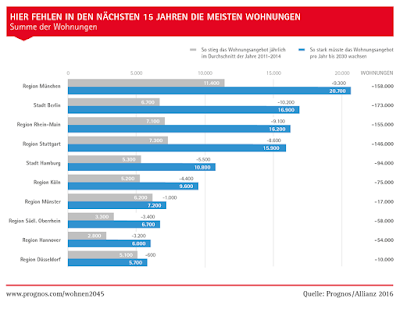
Why German Property Market Remains Attractive in the Next 15 Years

The housing shortage in Germany will grow if there is no significant increase in building activity. According to a study Prognos AG has delivered for Allianz Building Finance in the 15 most dynamic local markets there will be a shortcoming of close to one million apartments in the next 15 years. The 10 regions with the biggest supply deficits are München, Berlin, Rhein-Main, Stuttgart, Hamburg, Köln, Münster, Upper Rhine region (Freiburg/Offenburg), Hannover and Düsseldorf. The situation could relax by 2045 but only if there is no slacking in the building activities. Despite current immigration and refugee influx the main driver behind the development is internal migration which is currently responsible for 73% of changes in the housing market.

1 Million Apartments Gap in Germany 

The full report in German is available here: Prognos Living in Germany 2045
For support in property search and assessment in the German Property Market please contact us directly: Contact form


Share/Bookmark

Sunday, 21 February 2016

German Housing Market – Price Development in 2015 (Deutsche Bundesbank)


The German Federal Bank (Deutsche Bundesbank) has provided an analysis of the developments in the German Residential Market in their Monthly Report February 2016 https://www.bundesbank.de/Redaktion/DE/Downloads/Veroeffentlichungen/Monatsberichte/2016/2016_02_monatsbericht.html. The analysis is based on research data published by other institutions like vdp (Verband deutscher Pfandbriefbanken) or bulwiengesa AG.

 Price Development

In 2015 the prices for residential properties saw a significant increase. The spread across the country was wider than in the previous year. The price effect of growing demand combined with continuing favorable financing conditions was again stronger than any increase in availability of housing. Based on price determining economic and demographic factors the value of properties in urban areas will remain high and growing.

Based on information by bulwiengesa AG, prices for residential properties in German cities increased by 6% in 2015 after 5.5% in 2014 and 7.5% in 2013. The prices increase for condos was 6.5%, higher than single and semi-detached houses. Also the price increase for multi-tenant blocks was higher than the annual average since the beginning of the recent upswing in the German property market.

The average price increase for residential properties across all types in big cities slowed down compared to previous years and was the same as in cities in general at 6.25%. The increase for apartment blocks was at 7.25% by 2.0% higher than the average since 2010.

Rent Development

For new rental contracts in cities the increase was at 3.25% close to the previous year’s figure whereas the rent increase for new built apartments slowed down. In big cities the slow down on both categories was discernable. Whether this was due to the rent cap introduced in 2015 in Berlin, Hamburg, Düsseldorf, Frankfurt a.M., Köln, München Stuttgart and several smaller cities and towns.

Economic and Financing Development

The steady economic development in Germany with positive outlook for income and employment supported a strong demand in the residential market. While the price-income-ratio for owned housing increased over the period of the last 3 years the average interest rate decreased in 2015 by 0.5% to fewer than 2%.


Share/Bookmark

Friday, 30 October 2015

Residential Investment Opportunities and Risks in 50 German Cities


The German business journal Wirtschafts Woche has published an article "Wo Vermieter noch gut verdienen" comparing cities and regions assessing the risks and opportunities of investing in residential properties.
http://www.wiwo.de/finanzen/immobilien/wohnungsmarkt-wo-vermieter-noch-gut-verdienen/11771098.html
The article is in German and cotains a table that compares investment data for the 50 biggest German cities. The survey contains these data sets:
  • Gross starting yield
  • Average Purchase Price per m²
  • Net rent per m² per month
  • Price development
  • Price prognosis
  • Net Rent Development
  • Share of properties with more than 5% yield
  • Vacancy in %
  • Vacancy prognosis
Wirtschafts Woche comes to the conclusion that in the chase for better yields some investors are taking bigger risks, some without actual knowledge of the facts.
This table contains the above data with a color coded ranking for each criterion.


Larger View of Table
Click the table for a larger view


For property assessments of planned or existing investments feel free to contact me.


Share/Bookmark

Sunday, 12 April 2015

Property Health Check for Rented Apartment Blocks in Germany

In many dicussion with our clients we were asked to offer "just a quick status" and not the full service spectrum. At first we were reluctant as we felt that we would be taking a risk but then we realized that it actually is a smart approach. So we created and are still creating a set of "Health Checks" to "feel the pulse" of a property in order to identify possible problem areas to then determine with our client what could be achieved dealing with them.

The health of a property is determined by many factors, from structural status of the building to financial figures like yield or profit before interest. Even the financing structure can be a subject for a health check.
However all these factors influence some key measurements or Key Performance Indicators (KPI) that can be used as a starting point for a health check of a property. We have developed quick assessment processes to identify any possible problem areas in a property using e.g. rent level or utilities charges as KPIs and benchmark them against the market.


These are the initial services at an introductory price level:
- Rent Level Benchmark
- Utilities Charges Benchmark
- "Ready for Selling" Audit

The links will take you to the details of the individual services.

Survey

 German Property Survey

Help us improve your results by taking our short survey. Receive one of our Property Health Check Benchmark Services FREE (actual price 49.00 € but value could be thousands).   


Share/Bookmark